
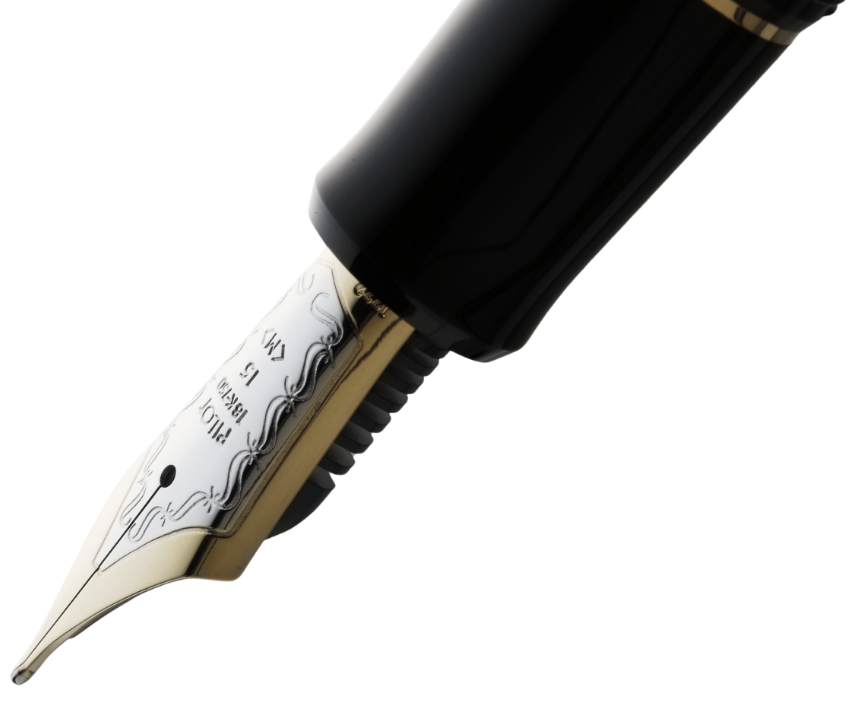
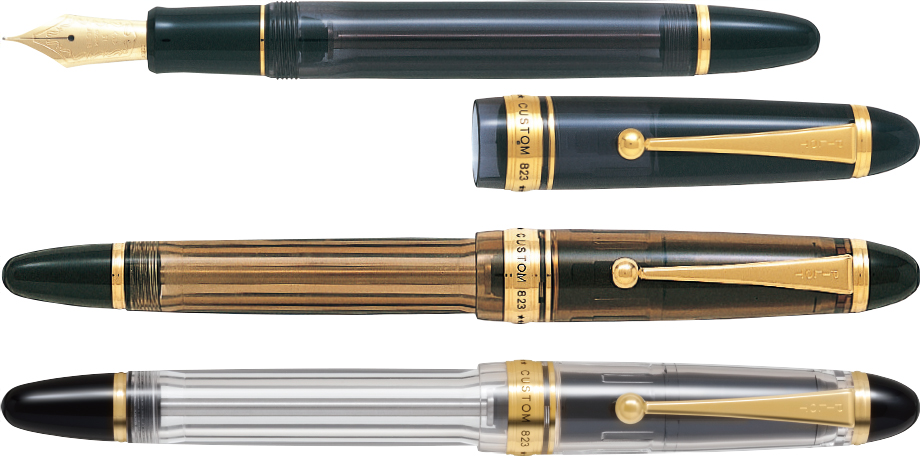
CUSTOM 823
FKK-3MRP
FKKE-3MRP
How to fill with ink
-
This product has an ink filling mechanism inside the body, so a cartridge or converter cannot be used with it.
When using the recommended bottle ink (INK-70) for plunger-type fountain pen
-
1
After making sure that the cap of the bottle is firmly tightened, turn the 70 ml ink bottle (INK-70) upside down. Then, set the bottle back upright. The plastic adapter located in the ink bottle should now be filled with sufficient ink to fill the pen.
-
2
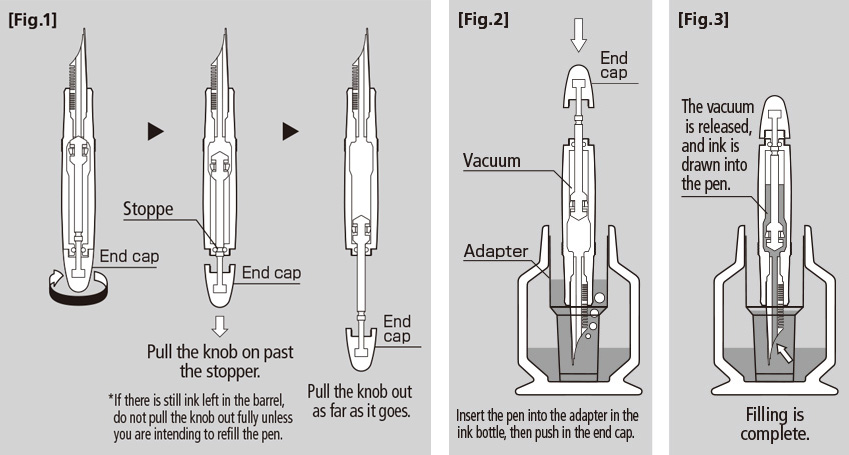
Remove the cap of the fountain pen and hold the nib tip upward. Slowly loosen the screw on the end cap by turning it in the direction of the arrow, then pull the end cap all the way out. [Fig.1]
-
3
Point the nib downward and insert it into the adapter inside the ink bottle. [Fig.2]
-
4
Hold the pen upright and push the knob back in. A vacuum is created, and ink is sucked into the pen as the knob is returned. [Fig.3]
-
5
After filling the pen with ink, it's safer to secure the end cap by turning it clockwise.
-
6
After drawing the ink, carefully lift the fountain pen from the ink bottle while remaining cautious of ink drips. Then, turn the nib upward and remove any excess ink with a soft cloth or similar material. In particular, make sure to completely wipe off any ink from areas other than the nib or feed tube.
When using inks other than the recommended bottle ink (INK-70) for plunger-type fountain pen
-
1
Remove the cap of the fountain pen and hold the nib tip upward. Slowly loosen the screw on the end cap by turning it in the direction of the arrow, then pull the end cap all the way out. [Fig.1]
-
2
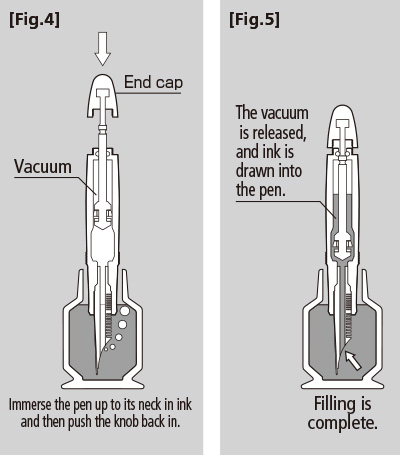
Turn the nib downward and dip it into the ink up to the neck. [Fig.4]
-
3
Hold the pen upright and push the knob back in. A vacuum is created, and ink is sucked into the pen as the knob is returned. [Fig.5]
-
4
After filling the pen with ink, it's safer to secure the end cap by turning it clockwise.
-
5
After drawing the ink, carefully lift the fountain pen from the ink bottle while remaining cautious of ink drips. Then, turn the nib upward and remove any excess ink with a soft cloth or similar material. In particular, make sure to completely wipe off any ink from areas other than the nib or feed tube.
* Be careful not to hit the bottle with the nib point to protect the nib.
Remarks The pen features a double-action stopper designed to prevent a messy withdrawal of the end cap section. It provides a certain amount of resistance (stopper) when pulling the end cap. If the end cap is pulled past the stopper while there is still ink in the barrel, it cannot be pushed back in until the ink inside the barrel has been disposed of.
Writing operation
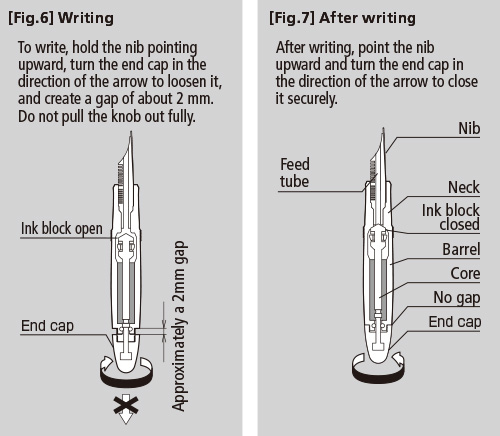
- Remove the cap of the fountain pen and hold the nib tip upward. Slowly loosen the screw on the end cap by turning it in the direction of the arrow. Then, slowly unscrew the end cap. The pen is ready for continuous writing when a gap of approximately 2 mm forms between the edge of the end cap and the metal ring. [Fig.6]
- After writing, hold the nib pointing upward and slowly turn the end cap screw in the direction of the arrow until it is fully closed. [Fig.7]
Care and Storage
- Keep the pen out of the reach of children and away from excessive heat, cold, or direct sunlight.
- If the pen is not used regularly, drain the ink from it. Then, clean the inside by filling and draining the pen with clean water several times.
- This pen contains custom-made precision parts. Do not try to repair it yourself.
Remarks
- Do not use except for writing.
- Keep away from children.
- Before changing the ink color, clean the inside by filling and draining the pen with clean water several times.
- Some lubricant has been applied to the mechanical parts and the inside of the barrel. It does not affect the quality of the product even though the pen body may look wet or colored lubricant could accumulate around the piston.
- Do not pull the end cap unless necessary.
- To prevent ink stains, keep the cap and the knob screwed tightly at all times when not writing.
- Changes in air pressure may cause the ink to leak or gush out, so do not use this pen on a plane.
- Please take care not to drop the pen as the shock could cause it to malfunction.
- Please be warned that applying chemicals, including solvents, such as alcohol, causes cracks or discoloration.
- Note that it may not be possible to remove this ink if it accidentally gets on your clothes.
- Pilot's Tsuwairo pigment ink for fountain pens is not compatible with this pen.
- Please use PILOT ink for fountain pens. Please note that mixing with other inks or old ink may cause problems.